The International Halal Science and Technology Conference 2025 (IHSATEC): 18th Halal Science Industry and Business (HASIB)
Item
-
Tittle
-
The International Halal Science and Technology Conference 2025 (IHSATEC): 18th Halal Science Industry and Business (HASIB)
-
Conference Acronym
-
IHSATEC 2025: 18th HASIB
-
DOI Number
-
https://doi.org/10.31098/ HST25137
-
Conference Date
-
December 18-19, 2025
-
Title
-
Porcine DNA Detection in Soy Sauce Using Real-Time PCR
-
presented at
-
The International Halal Science and Technology Conference 2025 (IHSATEC): 18th Halal Science Industry and Business (HASIB)
-
Poster Author(S)
-
Mohd Hazim Mohd Yusop
-
Conference Theme
-
IHSATEC 2025: 18th HASIB
-
Abstract
-
Background – Soy sauce is a common fermented condiment used especially in East and Southeast Asian cooking. Yet, food adulteration, or the inclusion of porcine ingredients, is still a point of concern for consumers following halal food regulations.
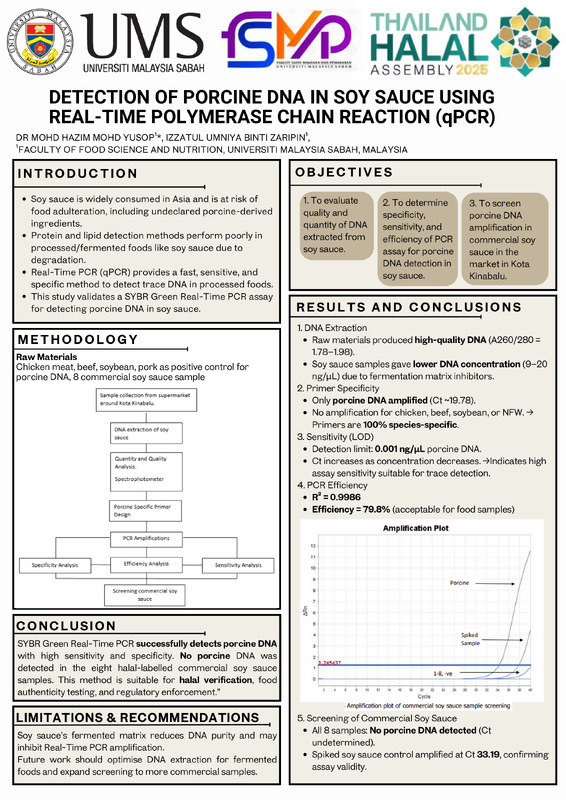
Purpose – This study aims to analyze the quality and quantity of DNA extracted from soy sauce, to determine specificity, sensitivity, and efficiency of PCR assay for porcine DNA detection and to screen porcine DNA in commercial soy sauce in the market.
Design/methodology/approach – Real-time PCR analysis was utilized for the rapidity, sensitivity, and specificity in detection and quantification of porcine DNA in soy sauce products. Specifically designed primers were constructed from the cytochrome b gene (S. scrofa domestica). DNA samples were extracted using Qiagen DNeasy Mericon Food. SYBR Green-based real- time PCR was conducted for DNA detection of 11 samples, two raw meat samples, one soybean sample, and eight soy sauce samples. PCR amplification was performed with an initial pre-denaturation at 95°C for 60 seconds, followed by 35 cycles of denaturation at 95°C for 15 seconds and combined annealing and extension at 60°C for 45 seconds.
Findings – Primer specificity was confirmed since the positive amplification was found to be for porcine DNA alone with a Ct value of 19.78 at 35 cycles. The technique possessed a detection limit of 0.001 ng/µL of porcine DNA. The efficiency of the real-time PCR assay from the regression analysis of the standard curve was 79.8% with a high R² value of 0.9986. There was no amplification of the DNA in any of the soy sauce samples, whereas in the spiked sample, amplification occurred at 33.19 Ct value.
Research limitations – Soy sauce sample is a highly process and fermented food which contains mixture of ingredients that can interfere with DNA extraction. Besides, presence of polyphenolic compounds in soy-derived products can inhibit PCR reactions and limit the quality DNA extracted from the sample. Thus, we suggest optimizing DNA extraction methods and using inhibitor removal steps to minimize PCR inhibition in future studies.
Originality/value – This study highlights real-time PCR as a powerful, fast, and sensitive method for detecting porcine DNA in processed food for halal food law enforcement and verification of food label authenticity.
-
Publisher Name
-
Yayasan Sinergi Riset dan Edukasi
-
Publication Date Online
-
December 18-19, 2025
-
page start
-
1