Navigating the Blue Ocean: How Telkom Indonesia Can Swim in the Emerging Space Economy
Item
-
Tittle
-
Navigating the Blue Ocean: How Telkom Indonesia Can Swim in the Emerging Space Economy
-
Conference Acronym
-
ICRES-ISCLO 2025
-
DOI Number
-
doi.org/10.31098/ISC25216
-
Conference Date
-
December 11-12, 2025
-
presented at
-
ICRES-ISCLO 2025
-
Poster Author(S)
-
- Furi Diah Ayu Hapsari | Telkom Indonesia | Indonesia
- Agvi Ramadhan Kurniawan | Telkom Indonesia | Indonesia
-
Conference Theme
-
“Accelerating Transformation Through Digital Innovation, Organizational Agility, and Strategic Collaboration for a Connected World”
-
Abstract
-
Background
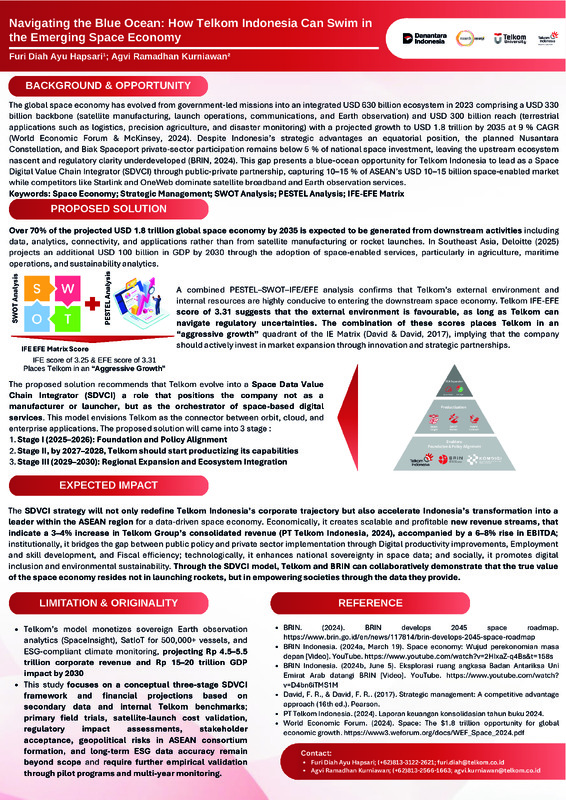
The global space economy has evolved from government-led missions into an integrated USD 630 billion ecosystem in 2023 comprising a USD 330 billion backbone (satellite manufacturing, launch operations, communications, and Earth observation) and USD 300 billion reach (terrestrial applications such as logistics, precision agriculture, and disaster monitoring) with a projected growth to USD 1.8 trillion by 2035 at 9 % CAGR (World Economic Forum & McKinsey, 2024). Despite Indonesia’s strategic advantages an equatorial position, the planned Nusantara Constellation, and Biak Spaceport private-sector participation remains below 5 % of national space investment, leaving the upstream ecosystem nascent and regulatory clarity underdeveloped (BRIN, 2024). This gap presents a blue-ocean opportunity for Telkom Indonesia to lead as a Space Digital Value Chain Integrator (SDVCI) through public-private partnership, capturing 10–15 % of ASEAN’s USD 10–15 billion space-enabled market while competitors like Starlink and OneWeb dominate satellite broadband and Earth observation services
Abstract Purpose
This paper aims to propose a strategic roadmap for Telkom Indonesia to enter the emerging space economy through Space Digital Value Chain Integrator (SDVCI) through public-private partnership, capturing 10–15 % of ASEAN’s USD 10–15 billion space-enabled market while competitors like Starlink and OneWeb dominate satellite broadband and Earth observation services.
Design/Methodology/Approach
A combined PESTEL–SWOT–IFE/EFE analysis confirms that Telkom’s external environment and internal resources are highly conducive to entering the downstream space economy.
Findings
Telkom IFE-EFE score of 3.31 suggests that the external environment is favourable, as long as Telkom can navigate regulatory uncertainties. The combination of these scores places Telkom in an “aggressive growth” quadrant of the IE Matrix (David & David, 2017), implying that the company should actively invest in market expansion through innovation and strategic partnerships.
Research Limitation
This study focuses on a conceptual three-stage SDVCI framework and financial projections based on secondary data and internal Telkom benchmarks; primary field trials, satellite-launch cost validation, regulatory impact assessments, stakeholder acceptance, geopolitical risks in ASEAN consortium formation, and long-term ESG data accuracy remain beyond scope and require further empirical validation through pilot programs and multi-year monitoring.
-
Publisher Name
-
Yayasan Sinergi Riset dan Edukasi
-
Publication Date Online
-
11-12-2025