Preliminary Survey and Profiling of Food Additives in Ultra-Processed Foods (UPFs) from Convenience Stores in Bangkok
Item
-
Tittle
-
Preliminary Survey and Profiling of Food Additives in Ultra-Processed Foods (UPFs) from Convenience Stores in Bangkok
-
Conference Acronym
-
IHSATEC 2025: 18th HASIB
-
DOI Number
-
doi.org/10.31098/HST25178
-
Conference Date
-
December 18-19, 2025
-
presented at
-
The International Halal Science and Technology Conference 2025 (IHSATEC): 18th Halal Science Industry and Business (HASIB)
-
Poster Author(S)
-
Acharee Suksuwan
-
Conference Theme
-
IHSATEC 2025: 18th HASIB
-
Abstract
-
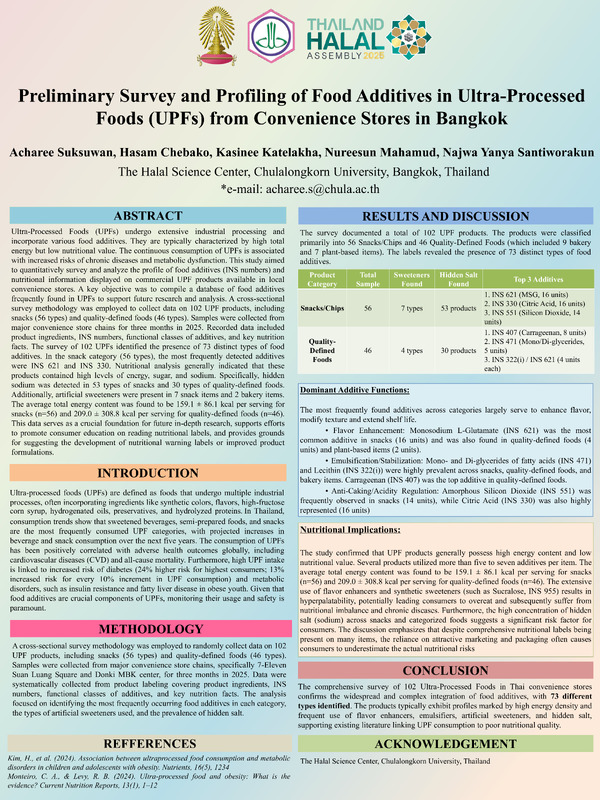
Background – Ultra-Processed Foods (UPFs) undergo extensive industrial processing and incorporate various food additives. They are typically characterized by high total energy but low nutritional value. The continuous consumption of UPFs is associated with increased risks of chronic diseases and metabolic dysfunction.
Purpose – This study aimed to quantitatively survey and analyze the profile of food additives (INS numbers) and nutritional information displayed on commercial UPF products available in local convenience stores. A key objective was to compile a database of food additives frequently found in UPFs to support future research and analysis.
Design/methodology/approach – A cross-sectional survey methodology was employed to collect data on 102 UPF products, including snacks (56 types) and quality-defined foods (46 types). Samples were collected from major convenience store chains for three months in 2025. Recorded data included product ingredients, INS numbers, functional classes of additives, and key nutrition facts.
Findings – The survey of 102 UPFs identified the presence of 73 distinct types of food additives. In the snack category (56 types), the most frequently detected additives were INS 621 and INS 330. Nutritional analysis generally indicated that these products contained high levels of energy, sugar, and sodium. Specifically, hidden sodium was detected in 53 types of snacks and 30 types of quality-defined foods. Additionally, artificial sweeteners were present in 7 snack items and 2 bakery items. The average total energy content was found to be 159.1 ± 86.1 kcal per serving for snacks (n=56) and 209.0 ± 308.8 kcal per serving for quality-defined foods (n=46).
Research limitations – Limitations included constraints on amount of samples, time and some products displayed incomplete nutritional information or lacked explicit numerical data for food additive quantities, necessitating that risk assessment rely on general standard information.
Originality/value – This study systematically compiled a preliminary database regarding the food additive profiles and nutritional data of UPFs available in Bangkok convenience stores. It offers evidence regarding the prevalence of various food additives and suboptimal nutritional components in widely consumed commercial products. This data serves as a crucial foundation for future in-depth research, supports efforts to promote consumer education on reading nutritional labels, and provides grounds for suggesting the development of nutritional warning labels or improved product formulations.
-
Publisher Name
-
Yayasan Sinergi Riset dan Edukasi
-
Publication Date Online
-
December 18-19, 2025