Escaping the Commodity Trap: Telkom's Wholesale NaaP Strategy for Autonomous Network Transformation and High-Margin API Monetisation
Item
-
Tittle
-
Escaping the Commodity Trap: Telkom's Wholesale NaaP Strategy for Autonomous Network Transformation and High-Margin API Monetisation
-
Conference Acronym
-
ICRES-ISCLO 2025
-
DOI Number
-
10.31098/ISC25182
-
Conference Date
-
December 11-12, 2025
-
presented at
-
International Conference on Research in Emerging Technologies and Strategic Business & The 10th International Seminar and Conference on Learning Organisation (ICRES-ISCLO)
-
Poster Author(S)
-
Ryan Achmad Arianto Ekasaputra | Telkom Indonesia | Indonesia
-
Conference Theme
-
“Accelerating Transformation Through Digital Innovation, Organizational Agility, and Strategic Collaboration for a Connected World”
-
Abstract
-
Background
Legacy telcos face the Commodity Trap, driven by declining revenue per unit and high operational expenditures. While leveraging advanced network capabilities is clear, the challenge remains in defining a strategic blueprint for legacy telcos—such as Telkom—to transform passive infrastructure into a high-value platform that enables growth across the digital value chain.
Abstract Purpose
This proposal addresses the need for legacy telcos to pivot to a high-margin revenue model beyond core connectivity. The Purpose is to validate and model the W-NaaP (Wholesale Network-as-a-Platform) strategy as a viable mechanism for Telkom to escape commoditisation by shifting from selling raw data to monetising programmable network capabilities via APIs. This transforms Telkom into a Strategic Platform Enabler.
Design/Methodology/Approach
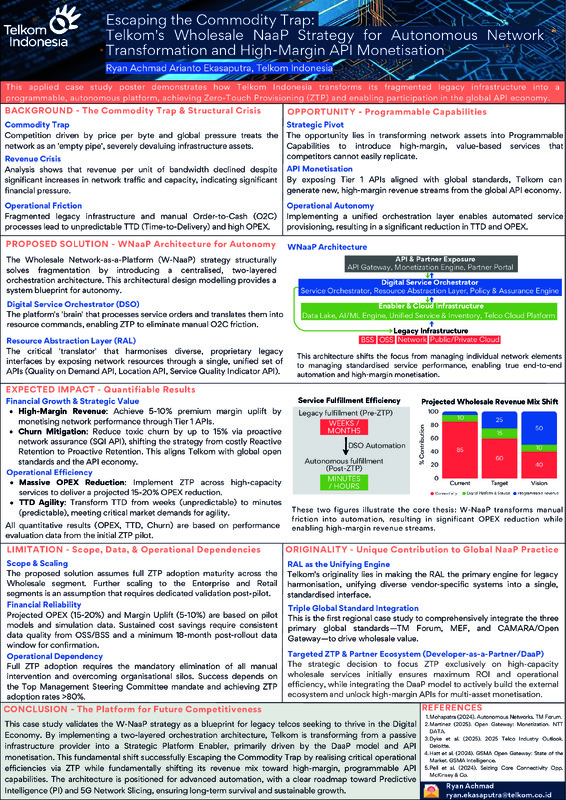
The approach employs design modelling of a two-layered orchestration architecture (RAL and DSO). Architectural design serves as a system blueprint, facilitating Zero-Touch Provisioning (ZTP) and automated service fulfilment. The RAL transforms raw capacity into programmable performance capabilities. Strategically, the Developer-as-a-Partner (DaaP) model underpins this, establishing a shared-success ecosystem. The RAL exposes dynamic network attributes (e.g., QoS, location API) as high-margin, standardised APIs for enterprise consumption, enabling API monetisation.
Findings
The analysis projects substantial quantitative impacts: OPEX reduction of up to 20%; Time-to-Deliver (TTD) reduced from weeks/months to minutes/hours via ZTP; and Churn Mitigation achieving up to 15% reduction by securing customers. These projections are derived from performance evaluation data for the initial ZTP pilot. Strategically, the wholesale revenue mix will shift: Programmable API Revenue (projected to grow to 50% Vision) insulates the business from low-margin connectivity erosion.
Research
The solution assumes full ZTP adoption maturity across the Wholesale segment and successful establishment of a global standard API ecosystem to drive market uptake. Further validation is required, including pilot data on actual B2B client adoption rates and margin uplift estimates beyond the 18-month projection period.
Originality/Value
This case study offers a unique, implementable blueprint combining operational efficiency (ZTP/Autonomous) with a financial pivot (API Monetisation/Revenue Mix Shift). It places the transformation within the context of a major legacy telco (Telkom), offering triple standard integration (GSMA, TM Forum, MEF) for global replicability and sustainable digital transformation within the Digital Economy.
-
Publisher Name
-
Yayasan Sinergi Riset dan Edukasi
-
Publication Date Online
-
11-12-2025