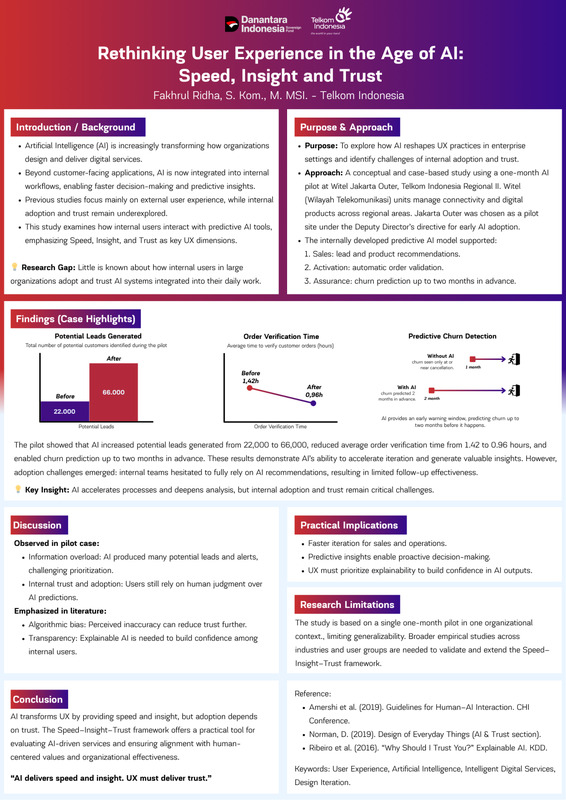
Rethinking User Experience in the Age of AI: Speed, Insight and Trust
Item
-
Tittle
-
Rethinking User Experience in the Age of AI: Speed, Insight and Trust
-
Conference Acronym
-
ICRES-ISCLO 2025
-
DOI Number
-
10.31098/ISC25141
-
Conference Date
-
11-12-2025
-
presented at
-
International Conference on Research in Emerging Technologies and Strategic Business & The 10th International Seminar and Conference on Learning Organisation (ICRES-ISCLO)
-
Poster Author(S)
-
Fakhrul Ridha | Telkom Indonesia | Indonesia
-
Conference Theme
-
“Accelerating Transformation Through Digital Innovation, Organizational Agility, and Strategic Collaboration for a Connected World”
-
Abstract
-
Background
Artificial Intelligence (AI) is transforming how organizations operate and design digital services. Beyond customer-facing applications, AI is increasingly embedded in internal workflows, enabling faster decision-making and predictive insights. However, most research on AI and User Experience (UX) focuses on external users, leaving a gap in understanding how internal users within large organizations adopt and trust AI systems. This study addresses that gap by exploring AI adoption and user experience from an internal perspective, emphasizing explainability and trust as key human-centered factors in enterprise contexts.
Abstract Purpose
This study aims to examine how AI reshapes UX practices through the framework of Speed, Insight, and Trust. It highlights the operational benefits and adoption challenges that emerge when predictive AI systems are integrated into internal workflows within a large telecommunications enterprise.
Design/Methodology/Approach
A conceptual and case-based approach was employed. The case study was conducted at Witel Jakarta Outer, a regional operational unit under Telkom Indonesia Regional 2, responsible for managing connectivity and digital product services. The site was selected as a pilot project under a Deputy Director directive due to its readiness for AI integration. The internally developed predictive AI model supported three processes: (1) Sales—lead and product recommendations, (2) Activation—automated order validation, and (3) Assurance—churn prediction up to two months in advance. Data were collected from system performance metrics and qualitative feedback from internal users.
Findings
The pilot results showed that potential leads generated increased from 22,000 to 66,000, order verification time decreased from 1.42 to 0.96 hours, and churn risks were predicted two months earlier. Despite these gains, internal teams hesitated to fully adopt AI recommendations, revealing challenges of trust and explainability.
Research
The study is based on a single one-month pilot in one organizational context, which may limit generalizability. Broader empirical research across multiple settings is needed to validate the findings.
Originality/Value
By framing AI’s impact through Speed, Insight, and Trust, this study provides a practical lens for evaluating AI-driven UX in enterprise settings. It bridges conceptual discussion with real-world implementation, emphasizing that AI’s success depends not only on performance but also on internal trust and adoption.
-
Publisher Name
-
Yayasan Sinergi Riset dan Edukasi
-
Publication Date Online
-
11-12-2025