Creating Shared Value through Digital Health Ecosystem : A Case Study of Telkom Employee Social Activity to Intervention Stunting in Southwest Papua
Item
-
Tittle
-
Creating Shared Value through Digital Health Ecosystem : A Case Study of Telkom Employee Social Activity to Intervention Stunting in Southwest Papua
-
Conference Acronym
-
ICRES-ISCLO
-
DOI Number
-
10.31098/ISC25211
-
Conference Date
-
December 11-12, 2025
-
presented at
-
International Conference on Research in Emerging Technologies and Strategic Business & The 10th International Seminar and Conference on Learning Organisation (ICRES-ISCLO)
-
Poster Author(S)
-
ILHAM HIMAWAN | Telkom Indonesia | Indonesia
-
Conference Theme
-
“Accelerating Transformation Through Digital Innovation, Organizational Agility, and Strategic Collaboration for a Connected World”
Abstract
-
Abstract
-
Background
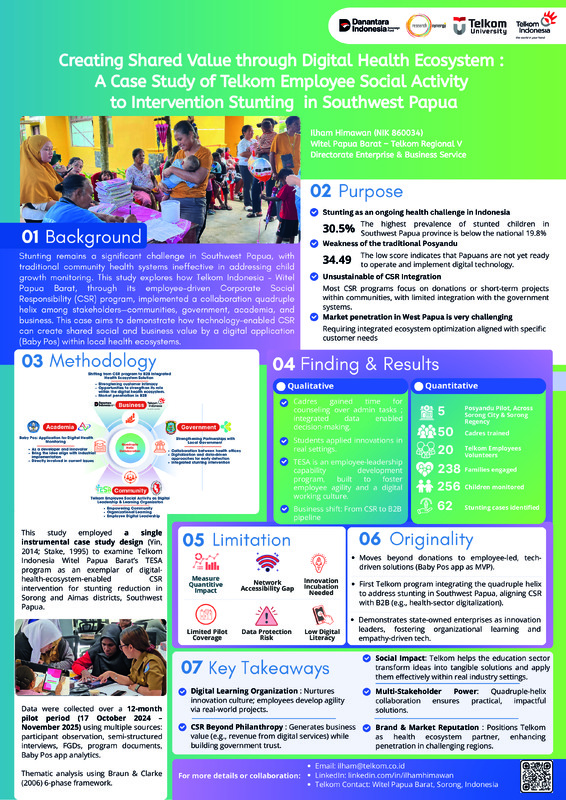
Stunting remains a significant challenge in Southwest Papua, with traditional community health systems ineffective in addressing child growth monitoring. This study explores how Telkom Indonesia – Witel Papua Barat, through its employee-driven Corporate Social Responsibility (CSR) program, implemented a collaboration quadruple helix among stakeholders—communities, government, academia, and business. This case aims to demonstrate how technology-enabled CSR can create shared social and business value by a digital application (Baby Pos) within local health ecosystems.
Abstract Purpose
- Stunting as an ongoing health challenge in Indonesia, 30.5% The highest prevalence of stunted children in Southwest Papua province is below the national 19.8%. - Weakness of the traditional Posyandu, - Unsustainable of CSR Integration. - Market penetration in West Papua is very challenging.
Design/Methodology/Approach
This study employed a single instrumental case study design (Yin, 2014; Stake, 1995) to examine Telkom Indonesia Witel Papua Barat’s TESA program as an exemplar of digital-health-ecosystem-enabled CSR intervention for stunting reduction in Sorong and Aimas districts, Southwest Papua. Data were collected over a 12-month pilot period (17 October 2024 – November 2025) using multiple sources: participant observation, semi-structured interviews, FGDs, program documents, Baby Pos app analytics. Thematic analysis using Braun & Clarke (2006) 6-phase framework.
Findings
- Cadres gained time for counseling over admin tasks ; integrated data enabled decision-making. - Students applied innovations in real settings. - TESA is an employee-leadership capability development program, built to foster employee agility and a digital working culture. - Business shift: From CSR to B2B pipeline
Research
The study was limited to a one-year pilot across five Posyandu sites, with challenges including limited internet infrastructure, data protection risk and varying levels of digital literacy among users. These factors may affect scalability and generalizability.
Originality/Value
This research demonstrates how a state-owned enterprise can transform CSR from philanthropy into a shared value strategy through digital health innovation and quadruple-helix collaboration. The Baby Pos initiative illustrates a replicable model for CSR-driven digital health interventions that simultaneously advance SDGs and business sustainability.
-
Publisher Name
-
Yayasan Sinergi Riset dan Edukasi
-
Publication Date Online
-
11-12-2025