Challenges and Motivation of Daughters in Sustaining Leadership Roles in Family Businesses
Item
-
Tittle
-
Challenges and Motivation of Daughters in Sustaining Leadership Roles in Family Businesses
-
Conference Acronym
-
IHSATEC 2025: 18th HASIB
-
DOI Number
-
doi.org/10.31098/HST25145
-
Conference Date
-
December 18, 2025
-
presented at
-
The International Halal Science and Technology Conference 2025 (IHSATEC): 18th Halal Science Industry and Business (HASIB)
-
Poster Author(S)
-
Salsabilla Nadifah
-
Conference Theme
-
IHSATEC 2025: 18th HASIB
-
Abstract
-
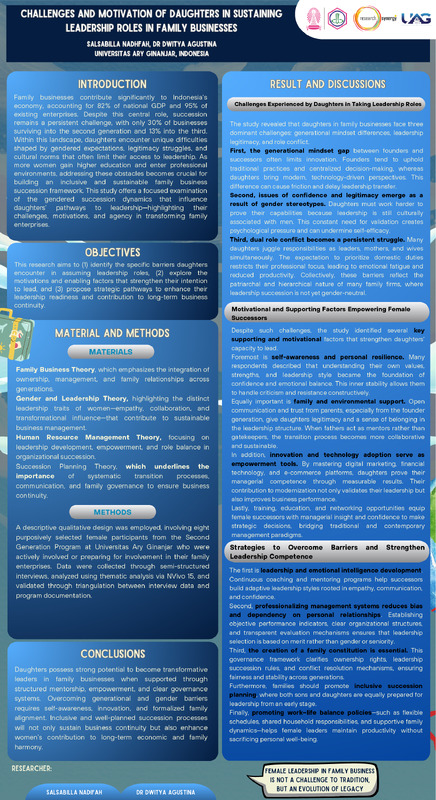
Background – Family businesses contribute significantly to Indonesia’s economy, accounting for 82% of national GDP and 95% of existing enterprises. Despite this central role, succession remains a persistent challenge, with only 30% of businesses surviving into the second generation and 13% into the third. Within this landscape, daughters encounter unique difficulties shaped by gendered expectations, legitimacy struggles, and cultural norms that often limit their access to leadership. As more women gain higher education and enter professional environments, addressing these obstacles becomes crucial for building an inclusive and sustainable family business succession framework. This study offers a focused examination of the gendered succession dynamics that influence daughters’ pathways to leadership—highlighting their challenges, motivations, and agency in transforming family enterprises.
Purpose – This research aims to (1) identify the specific barriers daughters encounter in assuming leadership roles, (2) explore the motivations and enabling factors that strengthen their intention to lead, and (3) propose strategic pathways to enhance their leadership readiness and contribution to long-term business continuity.
Design/methodology/approach – A descriptive qualitative design was employed, involving eight purposively selected female participants from the Second Generation Program at Universitas Ary Ginanjar who were actively involved or preparing for involvement in their family enterprises. Data were collected through semi-structured interviews, analyzed using thematic analysis via NVivo 15, and validated through triangulation between interview data and program documentation.
Findings – The findings show that daughters face intertwined challenges including generational mindset disparities, gender-based legitimacy issues, and competing personal–familial role demands. However, these challenges are countered by intrinsic motivation, self-awareness, parental trust, innovation capability, and leadership development programs. The study also reveals that structured governance—particularly through formalized managerial systems and family constitutions—supports a shift from traditional patriarchal succession toward merit-based, collaborative models. Sustainable leadership emerges when personal resilience aligns with supportive family structures and institutional empowerment.
Research limitations – While limited by its small, context-specific sample, this study provides valuable insight into daughters as active agents rather than passive successors.
Originality/value – It contributes to the literature by integrating gender, leadership, and governance perspectives and offers practical implications for designing inclusive succession strategies that strengthen women’s leadership roles and ensure intergenerational business sustainability.
-
Publisher Name
-
Yayasan Sinergi Riset dan Edukasi
-
Publication Date Online
-
December 18, 2025