Operationalizing a Learning Culture: Implementing a Learning Organization Framework in Indonesia’s Ministry of Finance
Item
-
Tittle
-
Operationalizing a Learning Culture: Implementing a Learning Organization Framework in Indonesia’s Ministry of Finance
-
Conference Acronym
-
ICRES-ISCLO 2025
-
DOI Number
-
10.31098/ISC25214
-
Conference Date
-
December 11-12, 2025
-
presented at
-
International Conference on Research in Emerging Technologies and Strategic Business & The 10th International Seminar and Conference on Learning Organisation (ICRES-ISCLO)
-
Poster Author(S)
-
- Siti Radhiatan Mardiah Daulay | Financial Education and Training Agency, Ministry of Finance | Indonesia
- I Putu Agus Arya Alit Suantara | Financial Education and Training Agency, Ministry of Finance | Indonesia
-
Conference Theme
-
“Accelerating Transformation Through Digital Innovation, Organizational Agility, and Strategic Collaboration for a Connected World”
-
Abstract
-
Background
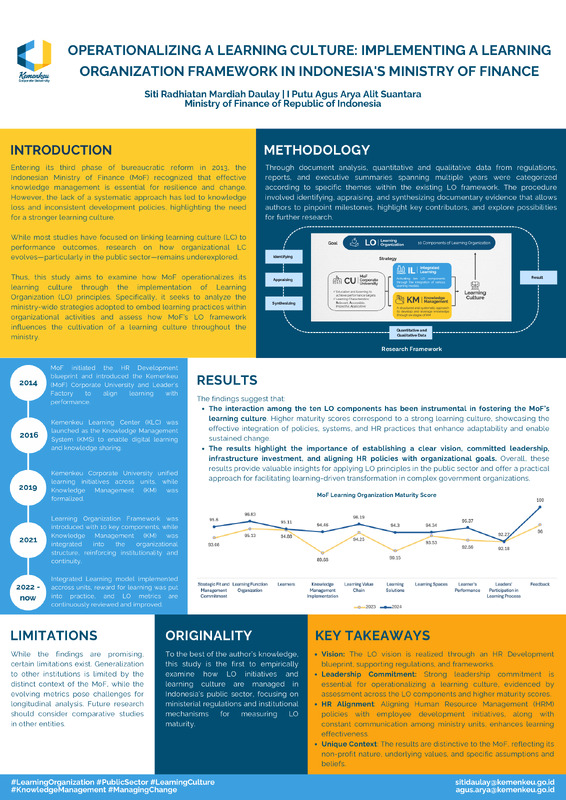
Entering its third phase of bureaucratic reform in 2013, the Indonesian Ministry of Finance (MoF) recognized that effective knowledge management is essential for resilience and change. However, the lack of a systematic approach has led to knowledge loss and inconsistent development policies, highlighting the need for a stronger learning culture. While most studies have focused on linking learning culture (LC) to performance outcomes, research on how organizational LC evolves—particularly in the public sector—remains underexplored.
Abstract Purpose
Thus, this study aims to examine how MoF operationalizes its learning culture through the implementation of Learning Organization (LO) principles. Specifically, it seeks to analyze the ministry-wide strategies adopted to embed learning practices within organizational activities and assess how MoF’s LO framework influences the cultivation of a learning culture throughout the ministry.
Design/Methodology/Approach
Through document analysis, quantitative and qualitative data from regulations, reports, and executive summaries spanning multiple years were categorized according to specific themes within the existing LO framework. The procedure involved identifying, appraising, and synthesizing documentary evidence that allows authors to pinpoint milestones, highlight key contributors, and explore possibilities for further research.
Findings
The findings suggest that the interaction among the ten LO components has been instrumental in fostering the MoF’s learning culture. Higher maturity scores correspond to a strong learning culture, showcasing the effective integration of policies, systems, and HR practices that enhance adaptability and enable sustained change. The results highlight the importance of establishing a clear vision, committed leadership, infrastructure investment, and aligning HR policies with organizational goals. Overall, these results provide valuable insights for applying LO principles in the public sector and offer a practical approach for facilitating learning-driven transformation in complex government organizations.
Research
Generalization to other institutions is limited by the distinct context of the MoF, while the evolving metrics pose challenges for longitudinal analysis. Future studies should consider comparative research in other entities.
Originality/Value
To the best of the author’s knowledge, this research is the first to empirically examine how LO initiatives and learning culture are managed in Indonesia’s public sector, focusing on ministerial regulations and institutional mechanisms for measuring LO maturity.
-
Publisher Name
-
Yayasan Sinergi Riset dan Edukasi
-
Publication Date Online
-
11-12-2025