-
Tittle
-
Implementing Bumn’s Employee Well-Being Policy: Baseline Survey and Strategic Well-Being Program for Telkomsigma
-
Conference Acronym
-
ICRES-ISCLO 2025
-
DOI Number
-
10.31098/ISC25212
-
Conference Date
-
December 11-12, 2025
-
presented at
-
International Conference on Research in Emerging Technologies and Strategic Business & The 10th International Seminar and Conference on Learning Organisation (ICRES-ISCLO)
-
Poster Author(S)
-
- Grace Elisabeth Lawas Lawu, ST., MBA | PT Sigma Cipta Caraka (Telkomsigma) | Indonesia
- Wiwin Agustina | Mind Power Management | Indonesia
- Muhammad Saiful Hidayat | PT Sigma Cipta Caraka (Telkomsigma) | Indonesia
- Luisa Amanda Charitas | PT Sigma Cipta Caraka (Telkomsigma) | Indonesia
- Prasetiyo Raharjo | Telkom Corporate University | Indonesia
-
Conference Theme
-
“Accelerating Transformation Through Digital Innovation, Organizational Agility, and Strategic Collaboration for a Connected World”
-
Abstract
-
Background
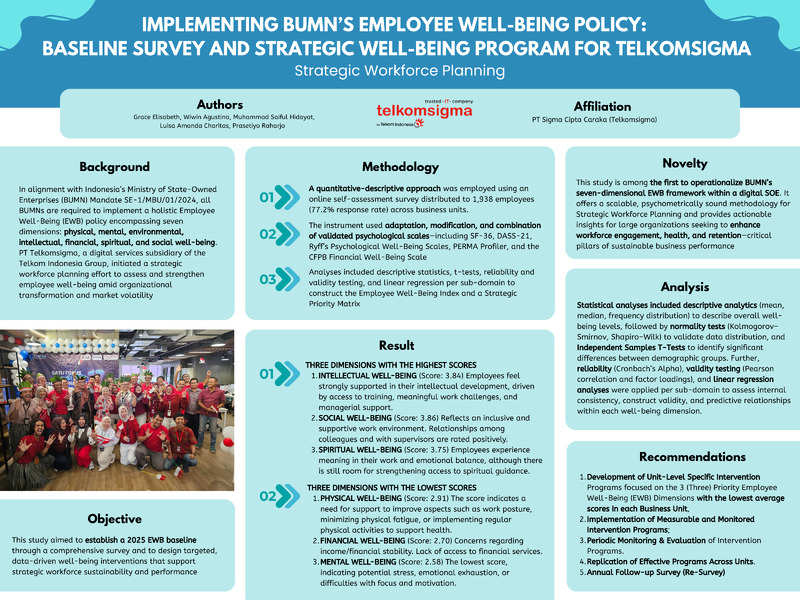
In alignment with Indonesia’s Ministry of State-Owned Enterprises (BUMN) Mandate SE-1/MBU/01/2024, all BUMNs are required to implement a holistic Employee Well-Being (EWB) policy encompassing seven dimensions: physical, mental, environmental, intellectual, financial, spiritual, and social well-being. PT Telkomsigma, a digital services subsidiary of the Telkom Indonesia Group, initiated a strategic workforce planning effort to assess and strengthen employee well-being amid organizational transformation and market volatility.
Abstract Purpose
This study aimed to establish a 2025 EWB baseline through a comprehensive survey and to design targeted, data-driven well-being interventions that support strategic workforce sustainability and performance
Design/Methodology/Approach
A quantitative-descriptive approach was employed using an online self-assessment survey distributed to 1,938 employees (77.2% response rate) across business units. The instrument integrated validated psychological scales—including SF-36, DASS-21, Ryff’s Psychological Well-Being Scales, PERMA Profiler, and the CFPB Financial Well-Being Scale. Analyses included descriptive statistics, t-tests, reliability and validity testing, and linear regression per sub-domain to construct the Employee Well-Being Index and a Strategic Priority Matrix
Findings
Results revealed the lowest scores in Physical (M = 2.86), Mental (M = 2.04), and Financial Well-Being (M = 2.74), highlighting urgent intervention areas. Demographic segmentation showed higher well-being among contract, married, and male employees, with outsourced and divorced staff exhibiting elevated risk. Regression models indicated that intellectual, social, financial, and environmental well-being significantly contribute to overall workforce health—directly influencing talent retention and organizational resilience. These findings informed evidence-based recommendations for Human Capital strategy and cultural transformation
Research
Limitations include reliance on self-reported cross-sectional data and a single organizational context, which may limit generalizability across the broader BUMN ecosystem
Originality/Value
This study is among the first to operationalize BUMN’s seven-dimensional EWB framework within a digital SOE. It offers a scalable, psychometrically sound methodology for Strategic Workforce Planning and provides actionable insights for large organizations seeking to enhance workforce engagement, health, and retention—critical pillars of sustainable business performance
-
Publisher Name
-
Yayasan Sinergi Riset dan Edukasi
-
Publication Date Online
-
11-12-2025