Reframing Corporate Sustainability through Maqashid Syariah: Evidence from Indonesia’s Green Industry
Item
-
Tittle
-
Reframing Corporate Sustainability through Maqashid Syariah: Evidence from Indonesia’s Green Industry
-
Conference Acronym
-
IHSATEC 2025: 18th HASIB
-
DOI Number
-
doi.org/10.31098/HST25135
-
Conference Date
-
December 18, 2025
-
presented at
-
The International Halal Science and Technology Conference 2025 (IHSATEC): 18th Halal Science Industry and Business (HASIB)
-
Poster Author(S)
-
Muhammad Rafi Thoriq
-
Conference Theme
-
IHSATEC 2025: 18th HASIB
-
Abstract
-
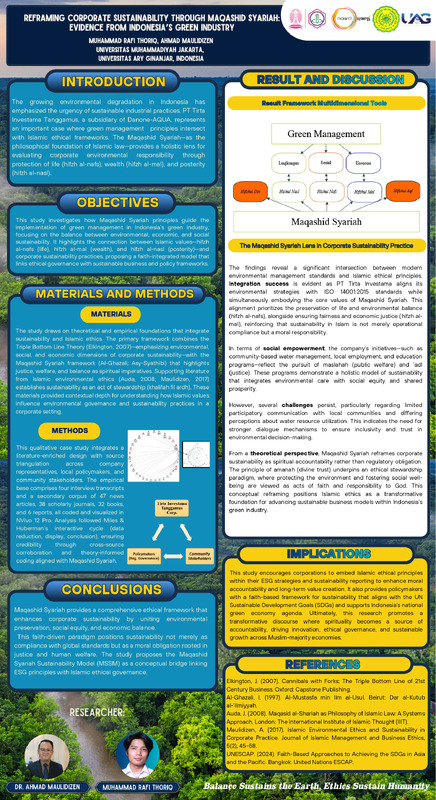
Background – The growing environmental degradation in Indonesia has emphasized the urgency of sustainable industrial practices. PT Tirta Investama Tanggamus, a subsidiary of Danone-AQUA, represents an important case where green management principles intersect with Islamic ethical frameworks. The Maqashid Syariah—as the philosophical foundation of Islamic law—provides a holistic lens for evaluating corporate environmental responsibility through protection of life (hifzh al-nafs), wealth (hifzh al-mal), and posterity (hifzh al-nasl).
Purpose – This study analyzes green management at PT Tirta Investama Tanggamus through a Maqashid Syariah lens, identifying enabling and inhibiting factors and evaluating socio-economic and ecological impacts on communities, clarifying how Islamic ethics shape sustainability practices and environmental governance.
Design/methodology/approach – This qualitative case study integrates a literature-enriched design with source triangulation across company representatives, local policymakers, and community stakeholders. The empirical base comprises four interview transcripts and a secondary corpus of 47 news articles, 38 scholarly journals, 32 books, and 6 reports, all coded and visualized in NVivo 12 Pro. Analysis followed Miles & Huberman’s interactive cycle (data reduction, display, conclusion), ensuring credibility through cross-source corroboration and theory-informed coding aligned with Maqashid Syariah.
Findings – The study finds that PT Tirta Investama’s green management practices strongly align with ISO 14001:2015 environmental standards and Maqashid Syariah principles. Environmental policies and operations reflect hifzh al-nafs (protection of life) through sustainable water and waste management, and hifzh al-mal (protection of wealth) through fair resource use and local economic contribution. Stakeholder engagement further embodies maslahah (public benefit) and ‘adl (justice) by empowering communities in environmental stewardship. However, challenges persist in participatory communication and differing community perceptions of water access. Overall, triangulated qualitative evidence confirms that Maqashid Syariah reframes corporate sustainability as spiritual accountability, extending beyond compliance toward ethical and holistic stewardship.
Research limitations – The study is confined to a single-site, time-bounded case relying primarily on qualitative evidence; future work should incorporate quantitative environmental performance indicators and multi-site comparisons to test transferability.
Originality/value – This research bridges Islamic jurisprudence and contemporary environmental management by proposing a Maqashid Syariah–based evaluative model for green industry governance, demonstrating how faith-driven ethical principles reinforce sustainability beyond compliance, advancing stewardship, accountability, and stakeholder legitimacy in Muslim-majority contexts.
-
Publisher Name
-
Yayasan Sinergi Riset dan Edukasi
-
Publication Date Online
-
December 18, 2025