Halal Certification as a Trust Signal in Muslim Consumers’ Purchase Intentions for Boocha Booms KombuchaD
Item
-
Tittle
-
Halal Certification as a Trust Signal in Muslim Consumers’ Purchase Intentions for Boocha Booms KombuchaD
-
Conference Acronym
-
IHSATEC 2025: 18th HASIB
-
DOI Number
-
10.31098/HST25111
-
Conference Date
-
December 18-19, 2025
-
presented at
-
The International Halal Science and Technology Conference 2025 (IHSATEC): 18th Halal Science Industry and Business (HASIB)
-
Poster Author(S)
-
- Bella Fujitha | Bandung Islamic University | Indonesia
- Tri Wahyu Nugroho | Universitas Islam Bandung | Indonesia
- Dian Suminar | Independent Researcher | Indonesia
-
Conference Theme
-
“Green Halal: Beyond Sustainability
-
Abstract
-
Background
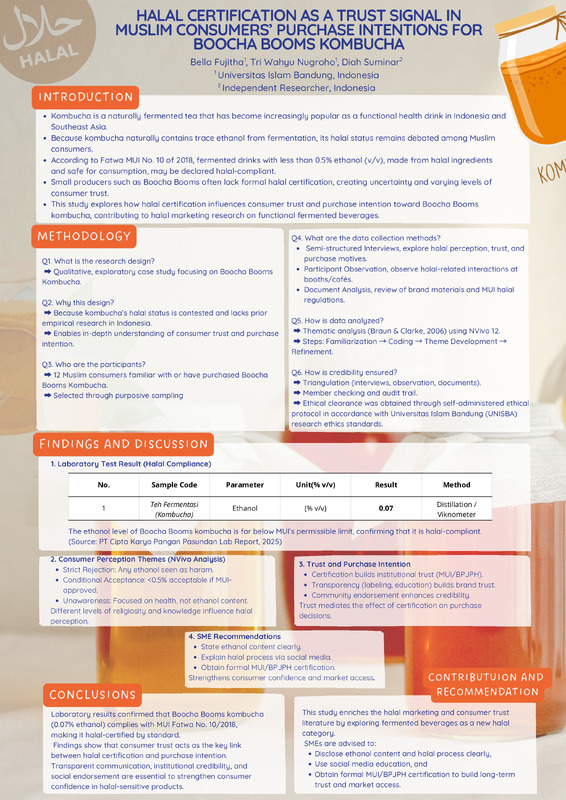
Kombucha, a fermented tea with probiotic benefits, is increasingly popular in Indonesia but remains controversial due to its natural ethanol content. Although MUI permits beverages with <0.5% ethanol (v/v), many Muslim consumers remain uncertain because of limited awareness and trust in halal certification. Existing studies mostly address conventional halal foods quantitatively, leaving a research gap on how halal certification and trust shape purchase intentions for emerging fermented products like kombucha.
Abstract Purpose
This study explores how halal certification and consumer trust affect purchase intention toward Boocha Booms kombucha, a local SME product lacking formal certification. It also extends the Theory of Planned Behavior by introducing trust as a mediator between halal certification and purchase intention in fermented functional beverages.
Design/Methodology/Approach
This study uses a qualitative case study approach on Boocha Booms kombucha in Indonesia, involving 12 Muslim consumers through interviews, observations, and document analysis. Data were thematically analyzed using NVivo, following Braun and Clarke (2006), with validity ensured through triangulation, member checking, and an audit trail.
Findings
The study found three consumer views on ethanol in kombucha—strict rejection, conditional acceptance, and unawareness. Trust mediates the link between halal certification and purchase intention, strengthened by MUI credibility, brand transparency, and community support. Lab tests showed 0.07% ethanol, confirming halal compliance. SMEs can build trust through clear labeling, education, and formal certification.
Research
The study’s limitations include a small sample size (12 participants). The findings are exploratory and may not be generalizable to all Muslim consumers in Indonesia. Future research could employ quantitative or mixed-method approaches to statistically validate the relationships between halal certification, trust, and purchase intention.
Originality/Value
This study contributes to the literature by extending the Theory of Planned Behavior with the mediating role of trust in the halal purchase context. It offers empirical insight into how Muslim consumers perceive halal credibility in an emerging functional beverage category. Practically, it provides guidance for SMEs to strengthen consumer trust through integrated halal communication, transparency, and formal certification strategies.
-
Publisher Name
-
Yayasan Sinergi Riset dan Edukasi
-
Publication Date Online
-
18-12-2025