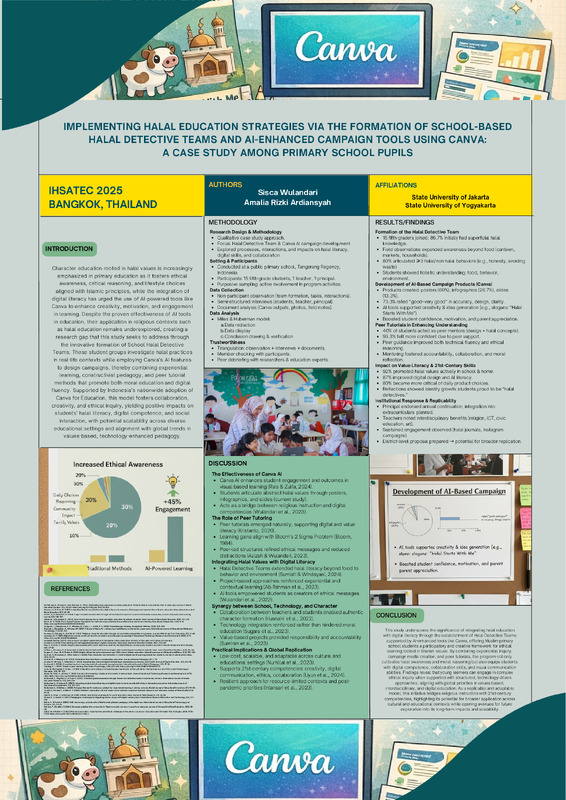
Implementing Halal Education Strategies via the Formation of School-Based Halal Detective Teams and AI-Enhanced Campaign Tools Using Canva: A Case Study among Primary School Pupils
Item
-
Tittle
-
Implementing Halal Education Strategies via the Formation of School-Based Halal Detective Teams and AI-Enhanced Campaign Tools Using Canva: A Case Study among Primary School Pupils
-
Conference Acronym
-
IHSATEC 2025: 18th HASIB
-
DOI Number
-
doi.org/10.31098/HST25151
-
Conference Date
-
December 18, 2025
-
presented at
-
The International Halal Science and Technology Conference 2025 (IHSATEC): 18th Halal Science Industry and Business (HASIB)
-
Poster Author(S)
-
Sisca Wulandari | State University of Jakarta | Indonesia
Amalia Rizki Ardiansyah | State University of Yogyakarta | Indonesia
-
Conference Theme
-
IHSATEC 2025: 18th HASIB
-
Abstract
-
Background – Character education rooted in halal values has become increasingly important in primary education, as it shapes students’ ethical awareness, reasoning, and daily practices consistent with Islamic principles. The integration of digital literacy further highlights the role of AI-powered tools like Canva, which promote creativity, engagement, and motivation. However, their implementation within religious education, especially halal learning contexts, remains underexplored, indicating a need for pedagogical innovation.
Purpose – This study aims to explore an innovative strategy for halal education through the establishment of School Halal Detective Teams and the development of AI-based campaign products using Canva. The research investigates how this integration of moral and digital learning can strengthen students’ understanding of halal concepts while enhancing their technological and social competencies.
Design/methodology/approach – The study employed a qualitative case study design involving primary school students who participated in the School Halal Detective Team program. Data were gathered through observation, interviews, and analysis of students’ Canva AI campaign projects. The study analyzed learning processes, collaboration patterns, and the pedagogical effectiveness of experiential, constructivist, and peer tutorial approaches.
Findings – Results indicate that the School Halal Detective Team model improved students’ halal literacy, creativity, critical thinking, and digital competence. The use of Canva AI encouraged students to design meaningful and visually engaging campaigns, fostering both ethical awareness and collaboration. The approach also promoted motivation, teamwork, and digital fluency aligned with global trends in technology-enhanced education.
Research limitations – The research was limited to a small group of students within one school context, which constrains the generalizability of results. Broader studies across schools or regions are needed to examine scalability and long-term impacts on moral and digital development.
Originality/value – This study introduces a unique pedagogical innovation that integrates halal education with AI-assisted learning through a project-based and peer-collaborative model. It provides a new framework for values-based, technology-supported instruction that aligns Islamic ethics with 21st-century digital competencies.
-
Publisher Name
-
Yayasan Sinergi Riset dan Edukasi
-
Publication Date Online
-
December 18, 2025