Faith-Driven Consumer Choices: Exploring the Role of Mui Fatwa in Moderating the Effect of Boycott Motivation on Gen Z’s Purchasing Behavior
Item
-
Tittle
-
Faith-Driven Consumer Choices: Exploring the Role of Mui Fatwa in Moderating the Effect of Boycott Motivation on Gen Z’s Purchasing Behavior
-
Conference Acronym
-
IHSATEC 2025: 18th HASIB
-
DOI Number
-
10.31098/HST25110
-
Conference Date
-
December 18-19, 2025
-
presented at
-
The International Halal Science and Technology Conference 2025 (IHSATEC): 18th Halal Science Industry and Business (HASIB)
-
Poster Author(S)
-
- Hana Hanifah | Universitas Ary Ginanjar | Indonesia
- Ahmad Maulidizen | Universitas Ary Ginanjar | Indonesia
-
Conference Theme
-
“Green Halal: Beyond Sustainability"
-
Abstract
-
Background
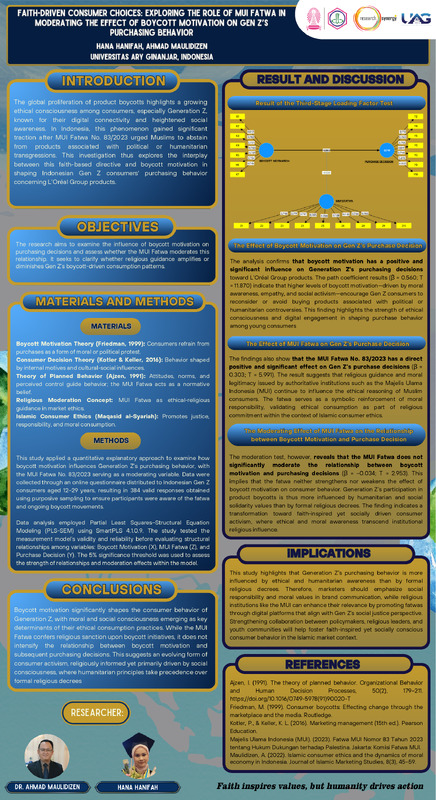
The global proliferation of product boycotts highlights a growing ethical consciousness among consumers, especially Generation Z, known for their digital connectivity and heightened social awareness. In Indonesia, this phenomenon gained significant traction after MUI Fatwa No. 83/2023 urged Muslims to abstain from products associated with political or humanitarian transgressions. This investigation thus explores the interplay between this faith-based directive and boycott motivation in shaping Indonesian Gen Z consumers' purchasing behavior concerning L’Oréal Group products.
Abstract Purpose
The research aims to examine the influence of boycott motivation on purchasing decisions and assess whether the MUI Fatwa moderates this relationship. It seeks to clarify whether religious guidance amplifies or diminishes Gen Z’s boycott-driven consumption patterns.
Design/Methodology/Approach
This quantitative study employs Partial Least Squares–Structural Equation Modeling (PLS-SEM) using SmartPLS 4.1. A total of 384 respondents, representing Indonesian Gen Z consumers aged 12–29, participated through an online survey. The model tested the relationships among Boycott Motivation (X), MUI Fatwa (Z), and Purchase Decision (Y) with a 5 percent significance level.
Findings
Results show that boycott motivation significantly and positively influences purchase decisions (T = 11.870; β = 0.560). The MUI Fatwa also has a direct positive effect (T = 5.991; β = 0.303), underscoring the role of religious authority in ethical consumption. However, its moderating effect is insignificant (T = 2.953; β = –0.034), indicating that Gen Z’s boycott participation is driven more by humanitarian and social solidarity than by formal religious edicts.
Research
The study focuses only on L’Oréal Group and Indonesian Gen Z, limiting broader generalization. Data collected via self-reported online surveys may also involve response bias.
Originality/Value
This research offers an empirical contribution to the study of Islamic consumer ethics, integrating religious authority with behavioral economics. It provides insights for policymakers, marketers, and scholars on how faith and social consciousness jointly influence purchasing behavior in Muslim-majority markets.
-
Publisher Name
-
Yayasan Sinergi Riset dan Edukasi
-
Publication Date Online
-
18-12-2025