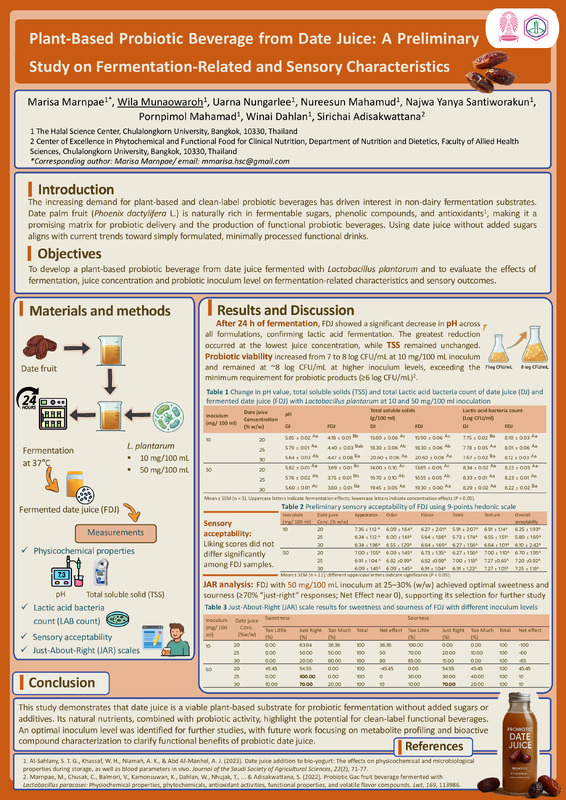
Plant-Based Probiotic Beverage from Date Juice: A Preliminary Study on Fermentation-Related and Sensory Characteristics
Item
-
Tittle
-
Plant-Based Probiotic Beverage from Date Juice: A Preliminary Study on Fermentation-Related and Sensory Characteristics
-
Conference Acronym
-
IHSATEC 2025: 18th HASIB
-
DOI Number
-
10.31098/HST25179
-
Conference Date
-
December 18-19, 2025
-
presented at
-
The International Halal Science and Technology Conference 2025 (IHSATEC): 18th Halal Science Industry and Business (HASIB)
-
Poster Author(S)
-
- Uarna Nungarlee | The Halal Science Center Chulalongkorn University | Thailand
- Nureesun Mahamud | The Halal Science Center Chulalongkorn University | Thailand
- Najwa Yanya Santiworakun | The Halal Science Center Chulalongkorn University | Thailand
- Marisa Marnpae | The Halal Science Center Chulalongkorn University | Thailand
- Pornpimol Mahamad | The Halal Science Center Chulalongkorn University | Thailand
- Winai Dahlan | The Halal Science Center Chulalongkorn University | Thailand
- Sirichai Adisakwattana | Department of Nutrition and Dietetics, Faculty of Allied Health Sciences, Chulalongkorn University | Thailand
-
Conference Theme
-
“Green Halal: Beyond Sustainability"
-
Abstract
-
Background
Growing interest in plant-based probiotic products has stimulated the search for non-dairy substrates capable of supporting probiotic growth while providing additional functional benefits. Date palm fruit (Phoenix dactylifera L.) is naturally rich in fermentable carbohydrates, phenolic compounds, and antioxidants, making it a promising medium for producing functional probiotic beverages.
Abstract Purpose
This preliminary study aimed to develop a plant-based probiotic beverage from date juice and to examine the effects of juice concentration and probiotic inoculum levels on fermentation-related characteristics and sensory outcomes.
Design/Methodology/Approach
Date juice prepared at 20, 25, and 30% (w/w) was fermented with Lactobacillus plantarum at two inoculum levels (10 and 50 mg/100 mL) for 24 h at 37°C. Physicochemical properties, viable cell counts, sensory acceptability, and Just-About-Right (JAR) profiles of the fermented date juice (FDJ) were assessed to identify promising formulations for subsequent optimization.
Findings
After 24 h of fermentation, FDJ showed a decrease in pH, with the greatest reduction at the lowest juice concentration, while total soluble solids remained unchanged. Probiotic viability increased from 7 to 8 log CFU/mL at 10 mg/100 mL inoculum but remained at approximately 8 log CFU/mL at higher inoculum levels. Preliminary sensory evaluation revealed no significant differences in sensory attributes or overall acceptability among FDJ samples; however, JAR analysis indicated that samples prepared with 50 mg/100 mL inoculum at 25 and 30% (w/w) juice concentration had the highest proportion of “just-right” ratings for sweetness and sourness, with acceptable Net Effect values. Overall, these findings suggest that date juice is a suitable substrate for probiotic beverage development and that the higher inoculum level tested may be a preferable condition for further development.
Research
Sensory evaluation was conducted with a small panel (n = 11) as a preliminary screening for optimization.
Originality/Value
This study provides initial evidence that date juice can serve as a viable plant-based substrate for probiotic fermentation without added sugars or additives. A combination of natural date-derived nutrients and probiotic fermentation presents a promising approach for developing clean-label functional drinks. Metabolite production and bioactive compounds should be further investigated to better characterize the functional potential of probiotic date juice.
-
Publisher Name
-
Yayasan Sinergi Riset dan Edukasi
-
Publication Date Online
-
18-12-2025