-
Tittle
-
A Study on the Physical Properties of Banana Flour as a Functional Ingredient for Food Applications
-
Conference Acronym
-
IHSATEC 2025: 18th HASIB
-
DOI Number
-
10.31098/HST25180
-
Conference Date
-
December 18-19, 2025
-
presented at
-
The International Halal Science and Technology Conference 2025 (IHSATEC): 18th Halal Science Industry and Business (HASIB)
-
Poster Author(S)
-
- Kasinee Katelakha | The Halal Science Center, Chulalongkorn University | Thailand
- Firadao Boonmalert | The Halal Innovation Community Learning Center, The Halal Science Center, Chulalongkorn University | Thailand
- Sarin Chaovasuteeranon | The Halal Innovation Community Learning Center, The Halal Science Center, Chulalongkorn University | Thailand
- Hasam Chebako | The Halal Innovation Community Learning Center, The Halal Science Center, Chulalongkorn University | Thailand
- Suwaibah Sulong | The Halal Innovation Community Learning Center, The Halal Science Center, Chulalongkorn University | Thailand
- Kunthira Salae | The Halal Science Center, Chulalongkorn University | Thailand
- Najwa Yanya Santiworakun | The Halal Science Center, Chulalongkorn University | Thailand
- Acharee Suksuwan | The Halal Science Center, Chulalongkorn University | Thailand
-
Conference Theme
-
“Green Halal: Beyond Sustainability"
-
Abstract
-
Background
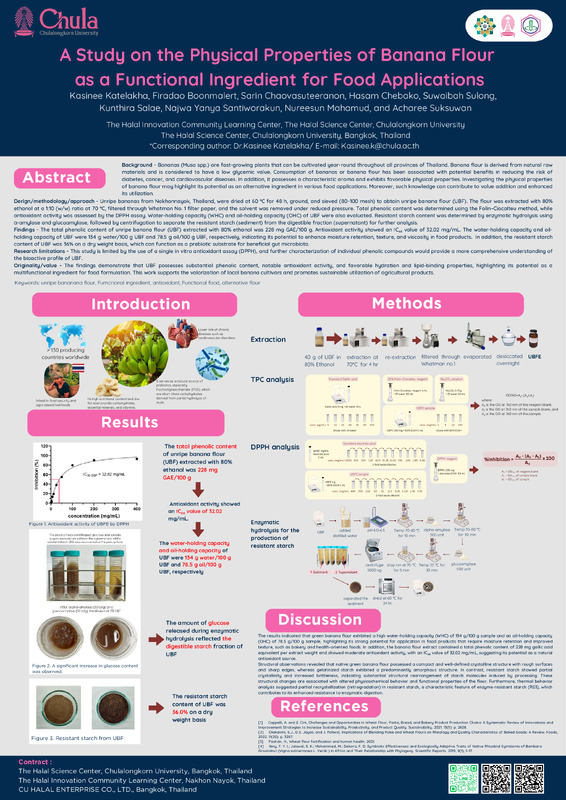
Bananas (Musa spp.) are fast-growing plants that can be cultivated year-round throughout all provinces of Thailand. Banana flour is derived from natural raw materials and is considered to have a low glycemic value. Consumption of bananas or banana flour has been associated with potential benefits in reducing the risk of diabetes, cancer, and cardiovascular diseases. In addition, it possesses a characteristic aroma and exhibits favorable physical properties. Investigating the physical properties of banana flour may highlight its potential as an alternative ingredient in various food applications. Moreover, such knowledge can contribute to value addition and enhanced its utilization.
Abstract Purpose
To determine the bioactive properties and functional characteristics of unripe banana flour (UBF) by evaluating its total phenolic content, antioxidant activity, and water and oil-holding properties, in order to assess its potential use as a functional ingredient.
Design/Methodology/Approach
Unripe bananas from Nakhonnayok, Thailand, were dried at 60 °C for 48 hours, ground, and sieved (80–100 mesh) to obtain UBF. The flour was extracted with 80% ethanol at a 1:10 (w/w) ratio at 70 °C, filtered through a Whatman No. 1 membrane, and the solvent was removed under reduced pressure. The phenolic content of the UBF crude extract was determined using the Folin–Ciocalteu reagent, while antioxidant activity was assessed using the DPPH assay. The water-holding capacity (WHC) and oil-holding capacity (OHC) of UBF were also determined.
Findings
The total phenolic content obtained from UBF extraction with 80% ethanol revealed that it was contained 228 mg GAE/100 g of total phenolic compounds. The antioxidant activity exhibited an IC₅₀ value of 32.02 mg/mL. The water-holding capacity and oil-holding capacity of UBF were determined to be 134 g water/100 g UBF and 78.5 g oil/100 g UBF, respectively. This property revelas that UBF could enhance moisture retention, texture, and viscosity in food products.
Research
This study is limited by the use of a single in vitro antioxidant assay (DPPH), and further characterization of individual phenolic compounds would provide a more comprehensive understanding of the bioactive profile of UBF.
Originality/Value
The findings demonstrate that UBF possesses substantial phenolic content, notable antioxidant activity, and favorable hydration and lipid-binding properties, highlighting its potential as a multifunctional ingredient for food formulation.
-
Publisher Name
-
Yayasan Sinergi Riset dan Edukasi
-
Publication Date Online
-
18-12-2025