Rapid Pork Adulteration Detection Using Colour and Texture Analysis Coupled with Machine Learning
Item
-
Tittle
-
Rapid Pork Adulteration Detection Using Colour and Texture Analysis Coupled with Machine Learning
-
Conference Acronym
-
IHSATEC 2025: 18th HASIB
-
DOI Number
-
doi.org/10.31098/HST25124
-
Conference Date
-
December 18, 2025
-
presented at
-
The International Halal Science and Technology Conference 2025 (IHSATEC): 18th Halal Science Industry and Business (HASIB)
-
Poster Author(S)
-
Fatin Fitriah
-
Conference Theme
-
(IHSATEC 2025: 18th HASIB)
-
Abstract
-
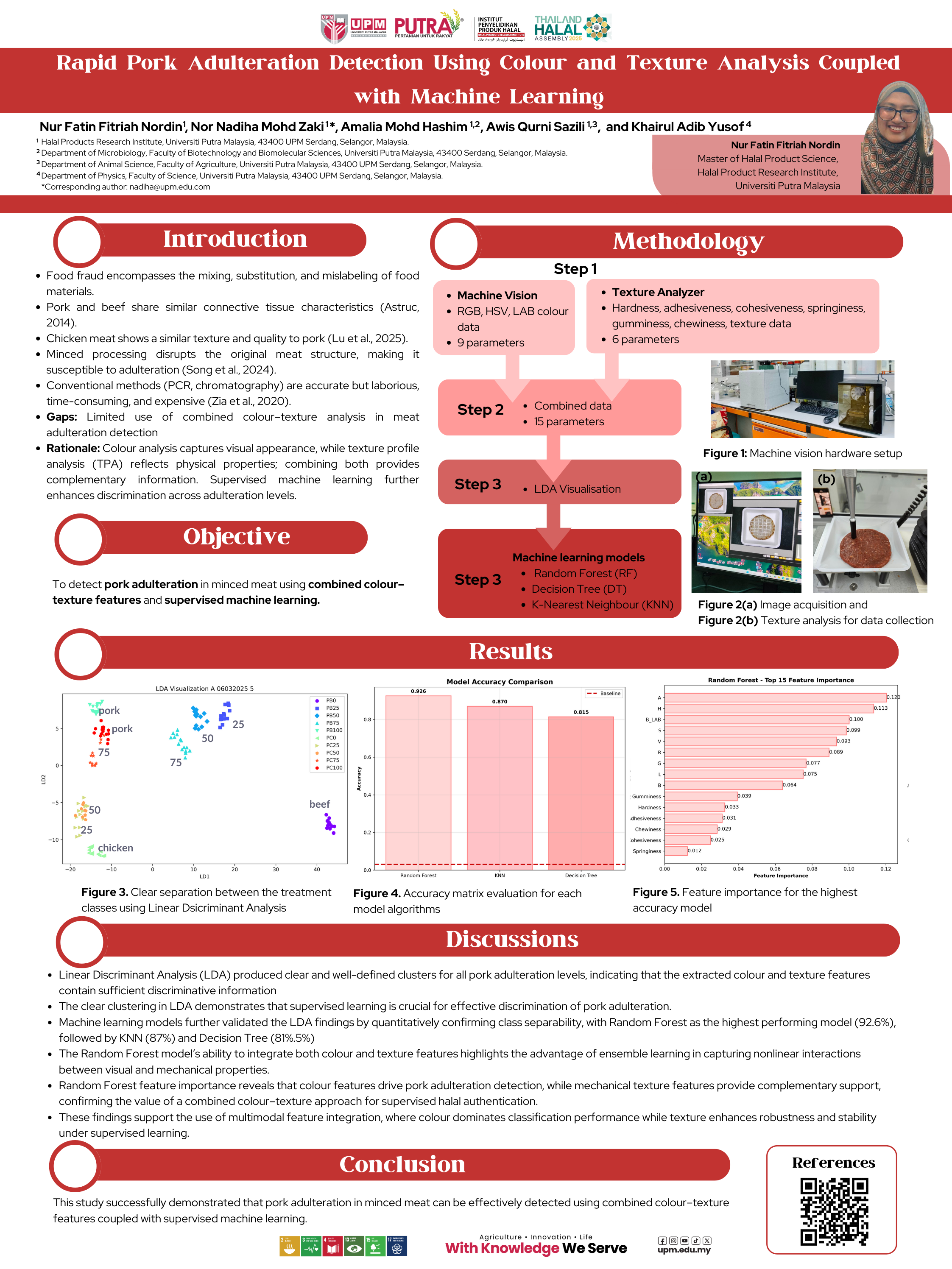
Background – Food adulteration is a serious crime that violates consumers’ trust, public health and religious dietary practices. This raises concern for the population with dietary restrictions, such as Muslims, since pork is prohibited in Islam. The colour similarity between pork and chicken and the textural resemblance between beef and pork facilitate the adulteration since the original morphological characteristics were destroyed. The conventional methods, like PCR and chromatography, are accurate, but it impractical for rapid, onsite adulteration detection due to the lengthy and tedious procedures.
Purpose – This study aims to develop a rapid, low-cost method for pork adulteration detection in minced beef and chicken by integrating colour and mechanical texture features with supervised machine learning models.
Design/methodology/approach – Fresh minced beef and chicken were adulterated with pork at five concentration levels (0%, 25%, 50%, 75%, and 100%). Colour features were extracted using a machine vision system, while texture parameters were obtained using a texture analyzer. Three machine learning algorithms, including Random Forest (RF), Decision Tree (DT), and K-Nearest Neighbour (KNN) were trained, tested, and validated using the same dataset for a multiclass classification. Model performance was evaluated based on the model accuracy.
Findings – Among the models tested, Random Forest achieved the highest classification accuracy (92.59%), followed by KNN (87.04%) and Decision Tree (81.48%). These high-accuracy model performance results indicate that the colour and texture data combination has high discriminatory power.
Research limitations – This study was conducted under controlled laboratory conditions using a limited number of meat sources. Sensitivity testing at lower adulteration levels (<25%) was not performed, limits the assessment of the model’s detection threshold.
Originality/value – This study demonstrates the potential of integrating image-based colour analysis and mechanical texture profiling with machine learning, highlighting the underutilized potential of texture features in halal authentication studies. The results indicate that colour and texture parameters contain high discriminatory information for detecting pork adulteration levels. The proposed approach provides a practical foundation for developing low-cost, reliable, portable tools for scalable field applications, enabling rapid on-site screening and inspection to support halal integrity and food traceability.
-
Publisher Name
-
Yayasan Sinergi Riset dan Edukasi
-
Publication Date Online
-
December 18, 2025