Trade-Based Money Laundering: Assessing Risks and Compliance for the Halal Agricultural and Food Supply Chain
Item
-
Tittle
-
Trade-Based Money Laundering: Assessing Risks and Compliance for the Halal Agricultural and Food Supply Chain
-
Conference Acronym
-
IHSATEC 2025: 18th HASIB
-
DOI Number
-
doi.org/10.31098/HST25108
-
Conference Date
-
December 18, 2025
-
presented at
-
The International Halal Science and Technology Conference 2025 (IHSATEC): 18th Halal Science Industry and Business (HASIB)
-
Poster Author(S)
-
Raja Madihah Raja Alias
-
Conference Theme
-
IHSATEC 2025: 18th HASIB
-
Abstract
-
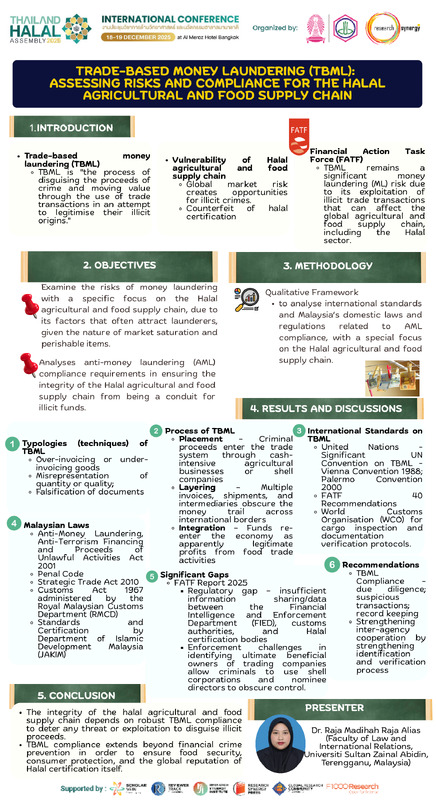
Background – Agricultural and food supply chains are among the economic sectors and products that are vulnerable to trade-based money laundering (TBML). The Financial Action Task Force (FATF) has highlighted that TBML remains a significant money laundering (ML) risk due to its exploitation of illicit trade transactions that can affect the global agricultural and food supply chain, including the Halal sector.
Purpose – This study aims to examine the risks of ML with a specific focus on the Halal agricultural and food supply chain, due to its factors that often attract launderers, given the nature of market saturation and perishable items. Consequently, this study analyses anti-money laundering (AML) compliance requirements in ensuring the integrity of the Halal agricultural and food supply chain from being a conduit for illicit funds.
Design/methodology/approach – This study employs a qualitative research approach by adopting a doctrinal legal method to analyse international standards and Malaysia’s domestic laws and regulations related to AML compliance, with a special focus on the Halal agricultural and food supply chain. This method enables an in-depth analysis to identify loopholes and challenges in current AML compliance and Malaysian statutory provisions related to TBML risks in the Halal sector.
Findings – This study finds that TBML is increasingly exploited for ML through the use of low-value and high-volume perishable goods. The misuse or falsification of Halal certifications and related documents further facilitates the embedding of illicit funds to disguise as legitimate import and export activities.
Research limitations – The scope of this study is limited to the examination of the risks involved for ML and the preventive measures requirements to deter TBML activities in the Halal agricultural and food supply chain based on international standards and Malaysian law. Further research should focus on best-practice countries in AML compliance within the Halal economy against TBML risks.
Originality/value – This study contributes to the existing literature on TBML, which emphasises AML compliance requirements for Halal agriculture and the food supply chain. This study will benefit policymakers and the Halal industry in ensuring that Malaysia safeguards the integrity of the financial system and protects food security in the Halal sector from exploitation by criminals for illicit crimes.
-
Publisher Name
-
Yayasan Sinergi Riset dan Edukasi
-
Publication Date Online
-
December 18, 2025